
Most people do not think of looking for geology from the sidewalks they travel, but for the intrepid geologist any good rock can tell a fascinating story. All one has to do is look at building stone in any large city to find a range of rocks equal to any assembled by plate tectonics. Furthermore, building stones provide the foundation for constructing stories about cultural as well as natural history. In his talk, David will explore stone ranging from 3.5-billion years old to 120,000 years old, the most commonly used building stone in the country, and rock used by the Romans to build the Colosseum. He will discuss history, transportation, and architecture to give you a new way to appreciate urban geology. Plus, we’ll even be“visit" a couple of quarries and see where the stone originates.
David B. Williams is an author, naturalist, and tour guide whose award-winning book Too High and Too Steep: Reshaping Seattle’s Topography explores the unprecedented engineering projects that shaped Seattle during the early part of the twentieth century. This talk is based on Stories in Stone: Travels Through Urban Geology. Williams is also a Curatorial Associate at the Burke Museum. His next book, Homewaters: A Human and Natural History of Puget Sound, will be published in April 2021.

All are welcome — no geological expertise is required — just curiosity about geoscience! This will be a casual conversation about news in geology this month followed by "show and tell." Sign up at our Meetup site.
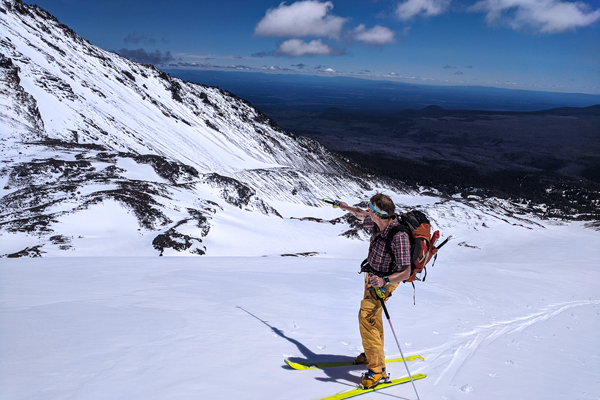
Almost a century ago, scientists and mountaineers in Oregon observed the retreat of Oregon’s glaciers and raised alarm over the potential for an ice-free Oregon in the not too distant future. That future has now arrived. The recently founded Oregon Glaciers Institute (OGI) is monitoring changes in Oregon’s endangered glaciers with the goal of projecting their viability. OGI recently concluded a state-wide survey of how many glaciers remain in Oregon with an estimate of how many existed more than 60 years ago when the last such census was conducted. In this presentation, we will look at the implications of these findings and why such changes are occurring (including Oregon’s geology and climate change), with a final note on how one can help in preserving Oregon’s vanishing glaciers.
Dr. Anders Carlson fell in love with glaciers as an undergraduate student while conducting research at Matanuska Glacier in Alaska. After receiving his B.A. in Geology and German from Augustana College, IL, he earned a M.S. at the University of Wisconsin-Madison and a Ph.D. at Oregon State University in glacial geology. Following a postdoc at Woods Hole Oceanographic Institution, MA, he was a professor at the University of Wisconsin-Madison and then Oregon State University before co-founding the Oregon Glaciers Institute. Anders has studied glacier-climate change for 20+ years in Alaska, Canada, Greenland, Svalbard, Scandinavia, Patagonia and Antarctica, with a new focus on glacier changes in the Pacific Northwest.
Geology Beginners, Avid Amateurs and Professionals — all are welcome! No geological expertise is required — just curiosity about geoscience! This will be a casual conversation about news in geology presented by PSU Grad Student Andrew Dunning and our panel of experts, followed by rock & fossil "show and tell." Dr. Emily Cahoon will be our special guest presenting her work on Oregon's beautiful sunstones! Sign up at our Meetup site.
Paleoseismic Evidence for Holocene Surface Rupturing Earthquakes on the Gales Creek Fault, Northwest Oregon & New Insights into Paleoseismic Age Models — Detrital Charcoal Inbuilt Ages
Little is known about the Holocene activity of northwest-striking faults in and around the Portland Basin. Recent paleoseismic studies of the Gales Creek fault (GCF) have yielded new earthquake-timing constraints for the 73-km-long, northwest-trending fault with youthful geomorphic expression. We excavated a paleoseismic trench across the GCF and document evidence of three surface rupturing earthquakes from stratigraphic and structural relationships. Radiocarbon samples from offset stratigraphy constrain these earthquakes to have occurred ~1,000, ~4,200 and ~8,800 calibrated years before present. Our results suggest the GCF has a recurrence interval of ~4,000 years and if the full 73-km length were to rupture it would result in a Mw 7.1 to 7.4 earthquake, providing a significant seismic hazard for the greater Portland Metropolitan area.
All are welcome — no geological expertise is required — just curiosity about geoscience! This will be a casual conversation about news in geology this month followed by "show and tell." Sign up at our Meetup site.

Our September speaker will be Dr. Victor R. Baker, Departments of Hydrology and Atmospheric Sciences, Geosciences, and Planetary Sciences, The University of Arizona.
In 1923, J Harlen Bretz, a recently tenured University of Chicago professor, newly appointed to the Journal of Geology editorial board, shocked the geological community with his paper in that journal proposing that an immense late Pleistocene flood had emanated from the margins of the nearby Cordilleran Ice Sheet. Cataclysmic flooding, which Bretz named the “Spokane Flood,” neatly accounted for numerous interrelated aspects of the Channeled Scabland landscape of eastern Washington, as well as features in nearby regions, including the Columbia Gorge, the Portland Basin, and the Willamette Valley.
All are welcome — no geological expertise is required — just curiosity about geoscience! This will be a casual conversation about news in geology this month followed by "show and tell." Sign up at our Meetup site.

Gather up your picnic food, BYOB, and join us from the comfort of your home or backyard to see Garret Romaine, Executive Director of the Rice Museum, and Sheila Alfsen, GSOC President, take us on a tour of the Rice Museum collections.