Caitlin Fernando, PSM candidate

I am a PSM Applied Geoscience student at PSU. My current internship focuses on sociohydrological systems in the Klamath Basin, where I’m developing causal loop diagrams and integrating datasets related to climate, agriculture, and water governance to better understand feedback between human and natural systems. In my first year, I completed a virtual internship with the Virtual Student Federal Service (VSFS) program through the U.S. Forest Service, where I worked on GIS-based analysis related to Wild and Scenic Rivers, which helped build my interest in applied hydrology and geospatial analysis.

Read More
Michelle Carlson, MS candidate

Research summary: The Blue Ridge fault (BRF), on the north slope of Mount Hood, is located ~60 miles from Portland, Oregon and nearby critical infrastructure such as the Bonneville Dam. My research combines field and computer-based surface mapping, fault displacement measurement, and age dating along the Blue Ridge fault to examine fault activity over the last million years. Careful measurement of faulted surfaces on a variety of units provides insight into past earthquake activity. Due to its proximity to critical infrastructure and nearby communities, understanding the potential hazards of this fault zone can inform future developments and emergency services.

Read More

Jacob Madore, MS candidate

My thesis is focused on investigating the effect of wildfires on the development of crack networks in bedrock. We are using permeability measurements to measure this, as more developed crack networks tend to have a higher permeability. We accomplished this using a tiny permeameter and the use of the bottomless bucket method to compute hydraulic conductivity. We have taken our measurements in areas of varying burn intensity and age. We also took ERT measurements and grain size distributions to compare resistivity and determine whether the areas had different weathering patterns.

Read More

Rachel Collins, PhD candidate

Thank you for the support provided through the Bev Vogt Graduate Research Grant. The award made it possible for me to complete an intensive 2025 field season in the southern Pueblo Mountains, where I am studying the newly identified Ladycomb Layered Mafic Intrusion (LLMI). The LLMI is a previously unmapped layered mafic intrusion on the Oregon–Nevada border that I discovered during my Master's research, and my dissertation aims to map its full extent, document its internal layering, understand how it formed, and it's relationship to nearby silicic calderas and hydrothermal Au/Ag/Cu mineralization. I use a combination of field mapping, petrography, and geochemistry to examine how mafic magmas moved through the crust and produced both layered rocks and copper- and Fe-Ti-V bearing mineralized zones. This work contributes to a broader understanding of magma plumbing beneath the Columbia River Basalt Group and magmatism in the northern Basin and Range.

Read More

Sandy Schwarzbart, MS candidate

My thesis examines faulting within the Mount Hood National Forest. Previous work mapped the Quaternary active Clackamas River Fault Zone (CRFZ) and the Holocene active Mount Hood Fault Zone (MHFZ). Lidar data collected in 2021 revealed previously unmapped lineaments between them. My study assesses the activity of these faults and their relationship to the proximal fault zones. Using lidar and a paleoseismic trench, we suggest these faults make up a Holocene active section of the CRFZ and may provide a kinematic link with the MHFZ.

Read More

CateLee Kambur, MS candidate

My M.S. thesis project is a groundwater flow system investigation of Columbia River Basalt-hosted aquifers in the Gorge. I'm interested in this area because of observed groundwater level declines in domestic water wells. Specifically, I'm focusing on the upper Rowena Creek area, which is located about 10 miles east of Hood River, just uphill from Mosier, OR. I'm studying this area due to its unique geologic setting, including the presence of a strike-slip fault that may impact groundwater flow and possible surface water-groundwater interactions occurring along Rowena Creek. My project utilizes water chemistry analysis and existing information on domestic water wells to study how groundwater flows in this area, with the goal of investigating why certain wells are declining while others are not.

Read More
Benjamin Botwe’ Agyemang, MS candidate

What processes may have formed/controlled the fabrics in ureilites?

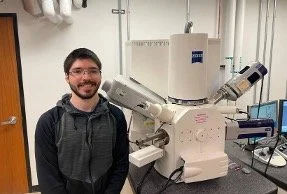
Ureilites is a type of meteorite which formed from the disruption of an asteroid. It consists of minerals such as olivine, pigeonite, troilite, and high-pressure carbon phases like graphite and diamond. These meteorites, which are linked to magmatic origins, show signs of shock impact deformation, with their minerals arranged in preferred patterns or orientations called fabrics. However, the mechanisms and processes behind the formation of these fabrics remains uncertain. My research goal is to investigate whether the fabrics in ureilites formed by either flow alignment process of restite origin, crystal settling process of cumulate origin, or shock deformation process. With the optical microscope and SEM-EBSD (Scanning Electron Microscope-Electron Backscattered Diffraction) techniques, I analyze the texture, crystal shapes and orientations to elucidate the formation history and evolutionary processes of ureilites.

Read More

Alyssa Smith, PhD candidate

My doctoral work focuses on understanding the chemical evolution of mafic (basalt and basaltic andesite) lavas in the central Oregon High Cascades. My overarching tasks are to 1) describe the distribution of mafic lavas in the Oregon High Cascades, 2) determine why basaltic andesites in particular are so abundant in this part of the Cascades, and 3) examine how the chemistry of individual volcanic centers compare to those in close proximity. I am using a combination of bulk rock geochemistry, new geologic dates, petrography, and eventually isotopes to answer these outstanding questions.

Read More

Obinna Ozioko, PhD candidate

My second project focuses on understanding a major earthquake that happened in Oregon roughly 1,000 years ago and what it might tell us about future earthquake risks in the region. Specifically, we’re looking at the Gales Creek Fault (GCF), a major fault line located west of Portland. While this fault hasn’t produced a recorded earthquake in modern times, previous studies have shown it has caused at least three big earthquakes in the last 8,000 years. The most recent one occurred between 1168 and 853 years ago. The aim of this study is to better understand how strong that earthquake was and how much shaking it caused, so we can better prepare for future ones. Earthquakes often cause landslides, especially in steep and mountainous areas. When a strong earthquake hits, it can trigger dozens or even thousands of landslides. These landslides can leave behind physical evidence on the landscape for thousands of years. By studying the shape and age of these landslides, we can learn more about when and where they happened—and possibly what caused them.

Read More

Cody Wilbur, MS candidate

The hillslope processes that shape the mountainous terrain of the Pacific Northwest have contributed significant changes to the region’s river systems. In September 2017, a large wildfire burned the mountainous terrain cradling Eagle Creek, a tributary to the Columbia River. Since the fire, Eagle Creek has begun the process of recovery. Previous post-fire research has found that the characteristics of hillslope processes are altered by wildfire but expected to return over time, however stream process responses are less understood. This study looks to quantify the changes and downstream impacts these processes have had on Eagle Creek following the fire.

Read More
Vincent Mugica, MS candidate

Hypervelocity impacts are the most important process in the entire field of Geology. Meteorites are the fragmented ejecta created during cosmic impact events and display evidence for shock metamorphism. This Master’s thesis seeks to characterize the shock micro-deformation of 3 L-chondrites, Buck Mountains 005, Tenham and NWA 11230 in order to reconstruct the shock conditions and petrogenesis of these meteorites. This has been done using a chemical-crystallographic technique, that entails the SEM-EDS-EBSD system at the Center for Electron Microscopy and Nanomaterials (CEMN) at PSU. This chemical-crystallographic technique has allowed us to determine (1) similar shock deformational systematics across differentially shocked meteorites and (2) highly variable magmatic processes occurring within meteorite shock melt veins (SMVs). This work has contributed to the field of meteorite shock science by correlating shock deformational trends as observed with EBSD to findings that utilize other methods such as Transmission Electron and Optical Microscopy. The chemical-crystallographic methods used in this study demonstrate promise in future work applied to other shocked meteorite classes and clans.

Read More

Daniel Sheikh, PhD candidate

Daniel Sheikh, PhD candidate

My work investigates small rock fragments (i.e., lithic clasts) found in lunar meteorites using electron microscopy-based techniques to better understand the magmatic evolution of the Moon and the role of hypervelocity impacts on physically and chemically modifying materials from the lunar surface. My current focus is on studying rare and unusual lithic clasts from the Moon enriched in a mineral called spinel; determining how these spinel-rich lithic clasts formed is pivotal to constrain the nature of secondary magmatism on the Moon and the interaction between the lunar crust and early produced partial melts of the lunar mantle.

Read More